Applying ASCE 7 and IBC Chapter 18 requirements in Virginia Beach means confronting the unique geotechnical puzzle of the Atlantic Coastal Plain. The city sits at roughly 36.85°N latitude, where Pleistocene-age sedimentary deposits — layers of sand, silt, and clay — extend well over 100 feet below sea level before hitting crystalline basement rock. This stratigraphy creates a pressing need to go beyond standard penetration resistance when designing deep foundations or analyzing slope stability near the Lynnhaven River watershed. A triaxial test provides the effective stress parameters (c' and φ') that index tests simply cannot deliver, especially when pore water pressure response under loading becomes the deciding factor in a foundation's performance. Our laboratory follows ASTM D4767 for consolidated-undrained conditions with pore pressure measurement and ASTM D2850 for unconsolidated-undrained scenarios, giving engineers the data they need to model Virginia Beach's interbedded soils accurately.
A single triaxial test on an undisturbed sample often reveals more about a soil's real field behavior than a dozen index tests combined.
Service characteristics in Virginia Beach
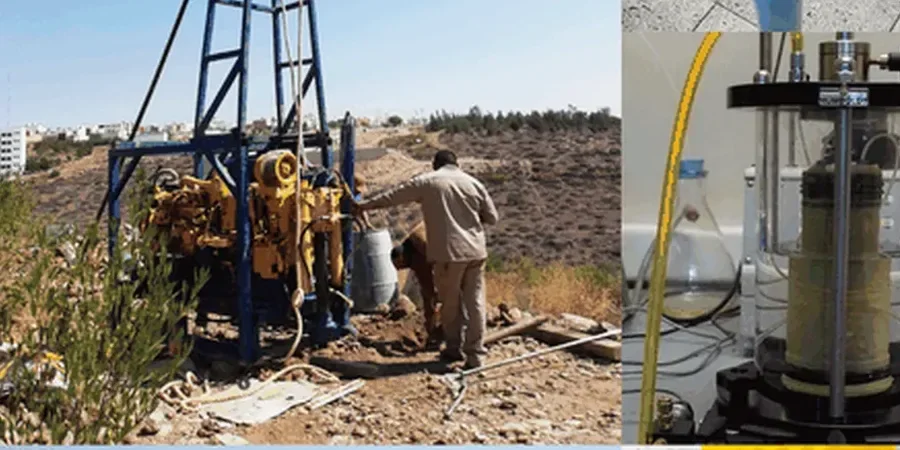
Local geotechnical conditions in Virginia Beach
Virginia Beach sits within a coastal region where the water table is frequently encountered within 4 to 8 feet of the ground surface, and much of the city's developable land is underlain by the Norfolk Formation — a mix of loose sands and soft organic silts deposited during interglacial highstands. These saturated, low-plasticity soils present a real risk of undrained failure during rapid loading from heavy structures or embankment fills. Without reliable shear strength data from a triaxial test on high-quality samples, a designer might underestimate the reduction in effective stress caused by excess pore pressure generation, leading to bearing capacity failures or excessive differential settlement. The same concern extends to the city's many waterfront developments along the Chesapeake Bay and Rudee Inlet, where fluctuating groundwater levels and tidal influence alter the in-situ stress state daily. Pairing triaxial results with a slope stability analysis becomes essential when grading near these water bodies, because the short-term, undrained condition often governs the factor of safety.
Our services
Our triaxial testing program in Virginia Beach covers the full workflow from sample extrusion to data interpretation, supporting geotechnical consultants and structural engineers across the Hampton Roads region. Each test is configured to match the anticipated field loading and drainage conditions.
Consolidated-Undrained (CU) Triaxial with Pore Pressure Measurement
The standard for determining effective stress strength parameters (c' and φ') in saturated, low-permeability soils. We run multistage or single-stage setups depending on sample availability, with back-pressure saturation verified by Skempton's B-value. This test is critical for modeling long-term stability of slopes and retaining walls in Virginia Beach's coastal clays.
Unconsolidated-Undrained (UU) Triaxial Testing
A rapid test for total stress parameters (cᵤ, φ=0) in fine-grained soils under fast, undrained loading. We use this method to evaluate the short-term bearing capacity of shallow foundations and the stability of temporary excavations, particularly in the soft silts common west of the Intracoastal Waterway.
Stress Path and Young's Modulus Testing
For projects requiring deformation parameters, we instrument specimens with local strain transducers and follow controlled stress paths. This provides the secant Young's modulus at various strain levels — data that finite element modelers need when simulating deep excavations or embankment construction on Virginia Beach's compressible soils.
Quick answers
When does a Virginia Beach project need a triaxial test instead of just SPT blow counts?
SPT data gives an empirical estimate of strength, but for critical structures — hospitals, mid-rise buildings, waterfront retaining walls — the IBC requires lab-derived shear strength parameters. In Virginia Beach's layered coastal deposits, blow counts alone cannot reliably distinguish between drained and undrained behavior or quantify effective stress parameters. A triaxial test becomes necessary whenever the design requires accurate c' and φ' values for bearing capacity, slope stability, or lateral earth pressure calculations.
What type of sample is needed and how should it be handled?
We test undisturbed samples collected with thin-walled Shelby tubes or piston samplers, typically 2.8 inches in diameter. The samples must be sealed immediately in the field with wax or plastic caps, kept at natural moisture content, and transported in cushioned containers to minimize disturbance. Samples should be extruded and tested within two weeks of recovery to preserve the in-situ structure — a timeline we strictly enforce in our lab.
How much does a triaxial test program cost in Virginia Beach?
A typical triaxial testing program — including sample extrusion, saturation, consolidation, and shearing for three specimens under different confining pressures — ranges from US$1,620 to US$2,750 depending on the number of stages and whether pore pressure measurement is required. Consolidated-undrained tests with pore pressure data fall toward the upper end, while a basic UU suite on three specimens is at the lower end. We provide a firm quote once we review the boring logs and project specifications.
How long does it take to get triaxial test results?
For a standard CU triaxial suite on cohesive soil, our turnaround is typically 8 to 14 business days from sample delivery. The consolidation phase alone can take several days in low-permeability clays, which is the main driver of the timeline. If the project schedule is tight, we can run a preliminary UU test within 5 business days and follow up with the full CU results once pore pressure equalization is complete.
Can you test granular soils or only cohesive materials?
We test both. For sands and silty sands common in Virginia Beach's upper strata, we prepare remolded specimens at the in-situ density and run consolidated-drained (CD) triaxial tests to determine the drained friction angle. For cohesive soils, CU and UU protocols apply. The key requirement is that the specimen diameter be at least six times the maximum particle size, which we verify during sample extrusion.