A recent warehouse expansion off Lynnhaven Parkway hit a snag when the subgrade passed proof-rolling but failed density verification by 4%. The contractor had been chasing moisture content in sandy loam that looked firm on the surface but was loose 18 inches down. That gap between visual confidence and measured reality is where the sand cone method earns its place. In Virginia Beach, with its mix of marine-deposited sands, silty cap layers, and scattered organic lenses left from drained pocosin wetlands, compaction acceptance can't rely on feel alone. Our team runs ASTM D1556 field density tests across the city—from Creeds to the Oceanfront—giving project managers the quantitative proof that backfill, base course, and structural fill meet the 95% or 98% Modified Proctor targets specified in the geotechnical report. When a CPT test flags weak zones during preliminary investigation, the sand cone becomes the frontline tool for verifying that subsequent compaction work actually closed the gap.
Compaction isn’t about how it looks from the cab of a roller. It’s about the number at the bottom of a 4-inch hole dug to spec.
Service characteristics in Virginia Beach
For projects near the resort strip where layered beach sands overlie compressible marsh deposits, achieving density is often less about compactive effort and more about lift thickness discipline. We commonly see 8-inch loose lifts specified for vibratory roller passes, with sand cone testing at every 2,500 square feet per lift. The data feeds directly into the engineer's acceptance letter and becomes part of the permanent project file.
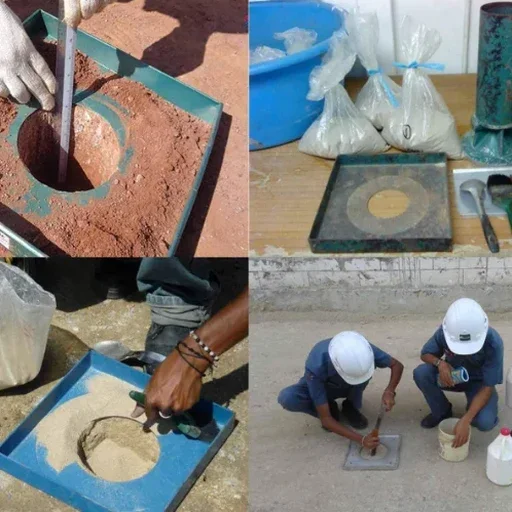
Local geotechnical conditions in Virginia Beach
Virginia Beach’s development boom from the 1960s onward pushed neighborhoods into areas that had been tidal marsh or low-lying farmland crisscrossed by drainage ditches. Many commercial sites along Virginia Beach Boulevard and Independence Boulevard sit on engineered fill placed decades ago under looser compaction standards—or no documented standard at all. When a new building pad or stormwater basin gets cut into that legacy fill, the density profile can be erratic: 92% here, 102% six feet away, and a pocket of 88% where an old stump rotted out. Skipping systematic field density verification on these sites invites differential settlement that shows up first as cracked slab-on-grade, then as binding doors, and eventually as ponding stormwater against foundation walls. The sand cone test, performed at the right frequency and documented with location discipline, catches those weak spots before concrete is placed. On state-funded VDOT projects within the city limits, density records are auditable deliverables—not optional—and a failed retest can delay the project schedule by days while undercut and recompaction cycles eat into the contractor’s margin.
Our services
Our field density program in Virginia Beach covers the full chain from lab Proctor reference to in-place verification, keeping your compaction QA defensible and your pay quantities undisputed.
In-Place Density Testing (Sand Cone)
ASTM D1556 testing at your site within 24 hours of request. We mobilize a two-person crew with calibrated Ottawa sand, digital scales, and field oven to deliver percent-compaction results keyed to station, offset, and lift number. Typical turnaround is same-day for small batches and next-morning for full-day testing sequences.
Laboratory Compaction Curves (Proctor)
Standard and Modified Proctor testing (ASTM D698 / D1557) on your borrow source or on-site fill material. The lab curve establishes the maximum dry density and optimum moisture content that field sand cone results are measured against. Without a current Proctor, field density numbers have no target.
Quick answers
What does a sand cone density test cost in Virginia Beach?
Single-point field density testing with the sand cone method typically runs US$100 to US$150 per test when performed as part of a larger QA/QC program. Mobilization may be quoted separately depending on site location—projects near Sandbridge or Pungo can carry slightly higher trip charges due to distance from our dispatch point. Volume pricing applies for ongoing earthwork monitoring with 10+ tests per visit.
How soon can you get a technician to my site?
For active earthwork operations inside Virginia Beach city limits, we typically schedule next-business-day visits. Urgent same-day requests are possible when a lift is ready for testing and weather windows are tight—call before 9 AM and we will work to route a crew to your site.
Why use the sand cone method instead of a nuclear density gauge?
The sand cone method is a direct measurement of mass and volume—no calibration curves, no radiation safety compliance, and no interference from soil chemistry that can skew nuclear gauge readings in coastal Virginia’s variable mineralogy. It is also the referee method: when nuclear gauge results are disputed, sand cone data is the accepted tiebreaker under ASTM and AASHTO standards.
How many tests do I need for a typical building pad?
Industry practice and IBC-referenced specs call for one field density test per 2,500 square feet per compacted lift, with a minimum of three tests per lift for pads under 5,000 square feet. Utility trenches generally require one test every 50 linear feet per lift, alternating sides. The exact frequency should be spelled out in the project’s geotechnical report and approved QC plan.