Virginia Beach's evolution from a quiet seaside resort to the most populous city in the Commonwealth has placed enormous pressure on its coastal margins. Every new subdivision carved into the old dune fields of Sandbridge or commercial infill near the resort strip inherits a legacy of Pleistocene sands and silts that behave unpredictably under lateral load. This is where retaining wall design transitions from a standard structural exercise into a careful negotiation with local stratigraphy. The Virginia Beach area sits roughly at 10 feet above mean sea level, with the water table often encountered just 4 to 6 feet below grade—a condition that defines virtually every design decision we make. Our team integrates slope-stability analysis with wall geometry from the earliest concept phase, ensuring the retained mass and the wall itself remain stable under storm-driven saturation scenarios.
A retaining wall in Virginia Beach is only as good as its drainage system—hydrostatic pressure, not earth pressure, causes most failures we encounter near the coast.
Service characteristics in Virginia Beach
Working video
Local geotechnical conditions in Virginia Beach
In Virginia Beach, we frequently see contractors and homeowners underestimate the speed at which a poorly drained wall can transition from serviceable to failed after a single nor'easter. The combination of a shallow water table, fine sand backfill, and a clogged weep system can generate full hydrostatic head within hours—something a wall designed only for drained conditions simply cannot resist. Another local failure mode involves global instability at the toe when walls are placed near existing slopes or bulkheads without extending the foundation deep enough to intersect a competent bearing layer. We have observed rotational slides initiating in the soft gray clay lenses that underlie many residential lots along the Lynnhaven River tributaries. Unlike inland sites where lateral earth pressure dominates the load case, coastal Virginia Beach retaining wall design must treat drainage and scour protection as equal partners to structural capacity. A thorough deep-excavations inspection protocol during construction helps us verify that subgrade conditions match the design assumptions before backfill placement begins.
Our services
Our retaining wall design services in Virginia Beach encompass the full lifecycle from feasibility to construction oversight, tailored to the specific demands of the coastal plain environment.
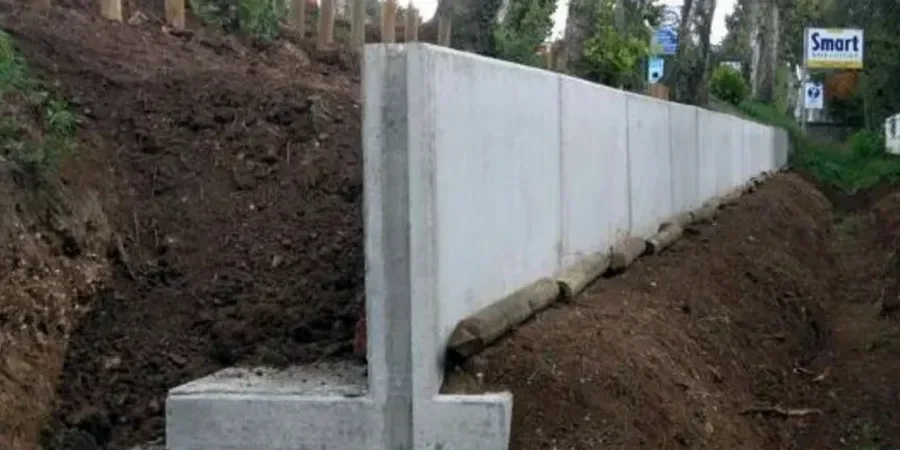
Cantilever and Counterfort Wall Design
Reinforced concrete walls engineered for cuts up to 25 feet, with detailed rebar schedules and joint layouts that accommodate thermal movement and differential settlement in sandy subgrades.
MSE Wall Design with Local Backfill
Mechanically stabilized earth solutions using geogrid reinforcement and locally sourced select fill, verified through grain-size and triaxial testing to meet AASHTO pullout resistance criteria.
Waterfront and Bulkhead Retaining Walls
Design of tied-back sheet pile walls and gravity structures for shoreline protection, incorporating scour analysis and corrosion protection for the aggressive marine environment.
Global Stability and Drainage Analysis
Integrated slope stability modeling using Spencer's method, combined with subsurface drainage design that includes chimney drains, blanket drains, and outlet systems sized for Virginia Beach storm events.
Quick answers
What is the typical cost range for a retaining wall design in Virginia Beach?
For a residential or light commercial retaining wall in Virginia Beach, the engineering design fee typically ranges from US$990 to US$3,780, depending on wall height, site access constraints, and the complexity of the subsurface conditions. Taller walls or those supporting roadway surcharge loads fall at the upper end of this range due to the additional global stability and seismic analysis required.
Do I need a building permit for a retaining wall in Virginia Beach?
Yes. The City of Virginia Beach requires a building permit for retaining walls that exceed 4 feet in height measured from the bottom of the footing to the top of the wall, or for any wall supporting a surcharge. Our design package includes sealed engineering drawings and calculations that satisfy the city's plan review requirements under the current IBC.
How does the high water table in Virginia Beach affect wall design?
The water table in much of Virginia Beach sits within 4 to 6 feet of ground surface, which means lateral earth pressures can double if the backfill is not properly drained. We design every wall with a solid drainage system—typically a chimney drain of clean stone and a perforated collector pipe at the base—and specify backfill material with a permeability of at least 10⁻³ cm/s to prevent hydrostatic pressure buildup.
What type of retaining wall works best in sandy coastal soils?
In the sandy stratigraphy typical of Virginia Beach, both reinforced concrete cantilever walls and mechanically stabilized earth walls perform well, provided the foundation bearing capacity is adequate. For waterfront applications, tied-back steel sheet pile walls offer the advantage of minimal excavation disturbance and can be designed to resist the additional loads from storm surge and scour that are common along the Chesapeake Bay and Atlantic shoreline.