A contractor recently broke ground on a commercial lot off Lynnhaven Parkway expecting a standard sandy loam subgrade. By mid-afternoon, the excavator was churning through saturated gray clay with zero structural capacity. That scenario repeats across Virginia Beach more often than it should—the coastal plain geology transitions from well-drained Pleistocene ridges to compressible marine deposits within a single parcel. Relying on assumed bearing values instead of a laboratory CBR test turns a straightforward paving job into an expensive subgrade failure. The soaked California Bearing Ratio test measures how the actual soil—compacted at project moisture and density—performs under a plunger load after four days of simulated saturation. For pavements carrying anything heavier than residential driveway traffic, those numbers determine whether the section works with 4 inches of stone or needs 14. When the flexible pavement design thickness hinges on a single parameter, the CBR value has to be right from the start.
In Virginia Beach, soaked CBR values routinely drop to one-third of the unsoaked number—designing from the wrong curve costs more than the test ever will.
Service characteristics in Virginia Beach
Local geotechnical conditions in Virginia Beach
Virginia Beach sits at an average elevation of 12 feet above sea level, with much of the developed corridor between Rudee Inlet and the Chesapeake Bay Bridge-Tunnel lying below 10 feet. That shallow water table is not just a construction nuisance—it's the controlling variable in pavement life. A CBR value tested unsoaked on a summer sample may read 15% or higher, but the same soil saturated during a nor'easter in February can collapse to under 3%. The difference translates to base course thickness errors of 6 to 10 inches, and on a half-mile access road, that's a six-figure overrun in aggregate alone. Beyond cost, a pavement built on overstated CBR values begins rutting within the first freeze-thaw cycle, creating liability for the design engineer and the contractor. The IBC and ASCE 7 reference the need for site-specific geotechnical parameters; a single borehole with an assumed CBR does not satisfy that standard. The laboratory CBR test, paired with a proper moisture-density curve, closes the gap between a cheap assumption and a defensible pavement section that lasts through Virginia Beach's wet, mild winters and hot, humid summers.
Our services
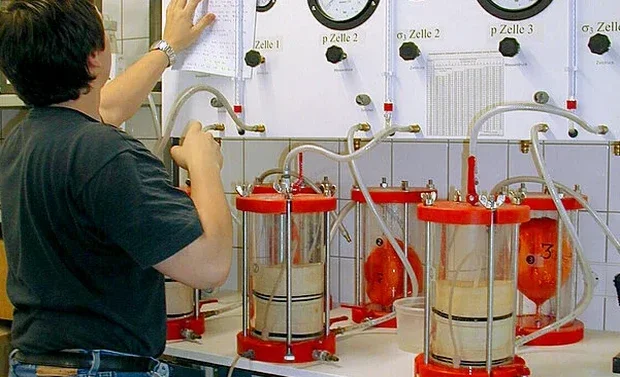
Our Virginia Beach laboratory runs CBR testing as part of a broader pavement evaluation workflow. Samples arrive from project sites across the city—from Shore Drive commercial pads to infill lots in Kempsville—and undergo the full soaked procedure with swell monitoring.
Soaked Laboratory CBR
The complete ASTM D1883 procedure with 96-hour saturation, swell tracking, and penetration testing at optimum moisture content. Delivers the corrected CBR value at both 0.1 and 0.2 inches of penetration, plus the stress-penetration curve.
CBR with Compaction Curve Package
Combines the CBR test with either Standard or Modified Proctor compaction to establish the moisture-density relationship. Essential for projects where the subgrade material is being placed as engineered fill and must meet a VDOT or local specification density target.
Quick answers
How much does a laboratory CBR test cost in Virginia Beach?
A single-point laboratory CBR test, including the companion Proctor compaction curve, runs between US$130 and US$180 depending on whether it's a standard or modified effort and how many points are tested. A full three-point CBR curve comes in at the higher end. Most pavement projects need at least two CBR tests—one for the subgrade and one for the base course material—so plan the sampling budget accordingly.
How long does the CBR test take from start to finish?
The soaking period alone is four days per ASTM D1883. Add compaction, setup, and the penetration test, and a typical turnaround is five to seven business days from sample receipt to report. Expedited scheduling is available when the sample arrives pre-molded at the target moisture and density from the field, but the 96-hour soak cannot be shortened without compromising the soaked CBR value.
Can you run a CBR test on aggregate base material?
Yes, and it is common practice for Virginia Beach road projects. The laboratory CBR test works on any material passing the 3/4-inch sieve, including VDOT 21A and 21B graded aggregate base. The procedure is the same as for subgrade soils—compacted at optimum moisture, soaked four days, and penetrated. Base course CBR values typically range from 40% to 80% or higher, which directly reduces the required asphalt or concrete thickness in the pavement design.