Virginia Beach presents a tale of two geologies. Head northwest toward the Kempsville area and you encounter the Pleistocene uplands with their compact sandy loams, while eastward toward the Atlantic Avenue corridor and the resort strip, the ground shifts to looser Holocene marine sands and artificial fill over marsh deposits. This contrast isn't just academic—it directly impacts how water moves through the subsurface. A dewatering plan that works flawlessly in the Western Bypass area can fail catastrophically near Rudee Inlet, where the water table sits just a few feet down. To navigate these transitions, contractors rely on in-situ permeability testing. The Lefranc method handles the saturated sands, while the Lugeon procedure quantifies rock mass permeability when foundations encounter the region's underlying sedimentary formations. Before finalizing a drainage scheme, our engineers often integrate the test pits data to visually confirm the stratigraphy, or run CPT soundings if continuous profiling is required in saturated zones.
A single permeability test run at the wrong depth in Virginia Beach's layered aquifer system can invalidate an entire dewatering design.
Service characteristics in Virginia Beach
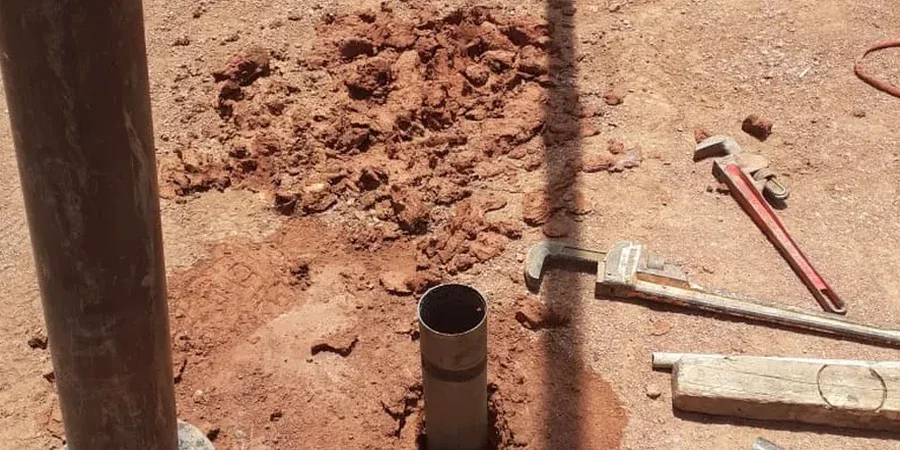
Local geotechnical conditions in Virginia Beach
The most common error local builders make is skipping field tests and relying solely on lab permeability from Shelby tube samples. In the loose, saturated sands common around the Green Run and Princess Anne districts, sample disturbance during extraction reduces void ratio and yields artificially low lab permeability. This leads to undersized wellpoint systems that fail to handle the actual inflow once excavation hits the real water table. The financial hit from a flooded excavation in coastal Virginia Beach—with its high water table and frequent tidal influence—can delay a project for weeks. Field tests like the Lefranc bypass this issue entirely by measuring the soil mass in its natural, undisturbed state. No remolding, no misinterpretation. The data reflects reality, which is exactly what the city's stormwater management regulations require when assessing infiltration feasibility.
Our services
Our field services in Virginia Beach focus on delivering accurate, repeatable hydraulic conductivity data that dewatering contractors and geotechnical engineers can use immediately. We handle everything from borehole preparation to data interpretation.
Lefranc Permeability Testing
Variable and constant head tests in soil boreholes. We target specific strata within the unconfined surficial aquifer to provide vertical profiles of hydraulic conductivity, essential for designing effective dewatering systems in Virginia Beach's sandy coastal plain.
Lugeon Packer Testing
Step-pressure injection tests for fractured rock assessment. We isolate discrete intervals within the borehole using pneumatic packers, quantifying water take and flow regimes to support deep foundation design where bedrock is encountered.
Quick answers
What is the typical cost for a Lefranc or Lugeon test in Virginia Beach?
The cost generally ranges from US$550 to US$990 per test interval, depending on depth, access conditions, and the number of stages required. Mobilization and report generation are usually quoted separately based on the project's scope within the Hampton Roads area.
When should I choose a Lugeon test over a Lefranc test?
The choice depends entirely on the subsurface material. Use the Lefranc method for unconsolidated granular soils, such as the sands and silts found across most of Virginia Beach. Switch to the Lugeon (packer) test when the borehole penetrates the Yorktown Formation or underlying bedrock, where fracture flow dominates permeability.
How long does a field permeability test take to complete?
A single Lefranc test stage typically requires one to two hours of field time once the borehole is prepared. A Lugeon test with multiple pressure steps in rock can take two to three hours per isolated interval. The timeline depends heavily on soil saturation rates and whether steady-state flow conditions are achieved quickly.