Drive ten minutes from the high dunes of Sandbridge to the low-lying marl clay of the Kempsville area and you'll feel the difference under your tires. Virginia Beach sits at the mouth of the Chesapeake Bay, where the Atlantic Coastal Plain layers wind-blown sands over marine silts and soft organic clays. A single lot can transition from clean medium sand to fat clay within six feet of depth. That contrast isn't academic—it dictates whether stormwater infiltrates or ponds, whether a slab needs undercutting, and whether a retaining wall drains freely or traps hydrostatic pressure. Grain size analysis with both sieve stacks and hydrometer sedimentation gives us the full particle-size distribution curve, from gravel down to colloidal clay. Without it, you're guessing which USCS group symbol applies. With it, you know precisely how the material will behave under load and moisture. Many local designs tie directly to the Atterberg limits suite for cohesive fractions and to CPT soundings when we need continuous stratigraphy across a site with erratic lenses.
A sieve stack tells you what the soil is. The hydrometer tells you what it's going to do when it rains.
Service characteristics in Virginia Beach
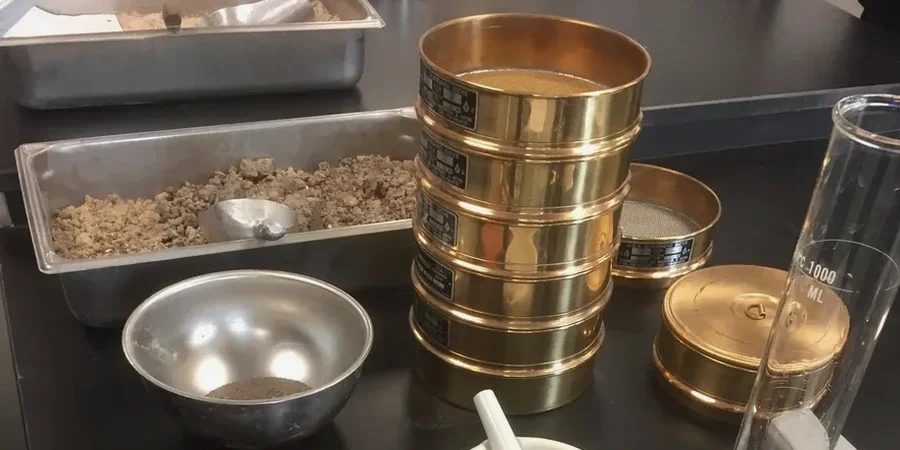
Local geotechnical conditions in Virginia Beach
Virginia Beach averages around 47 inches of rain a year, and our water table often sits just a few feet below grade. That combination punishes any soil with a high fines content. Silty sands that look stable in the dry season can lose half their bearing capacity when saturated, and fat clays shrink and swell enough to crack slabs and shear utility connections. The real risk isn't just settlement; it's differential movement across a footprint that straddles two different soil units. A grain size curve that reveals a gap-graded sand or a 40% silt fraction is an early warning that standard compaction specs won't hold. It also flags frost susceptibility in shallow footings, even in our relatively mild winters. Skipping the hydrometer portion of the test means you miss the clay-size fraction entirely—and that's exactly the fraction that controls drainage, capillary rise, and long-term volume stability. When we run the full ASTM D422/D6913 suite, we're not just classifying soil; we're mapping out where the water will go and what it will do once it gets there.
Our services
Our grain size testing supports a range of geotechnical and construction-phase decisions across the Hampton Roads region. Every report includes the complete gradation table, the particle-size distribution curve on a semi-log plot, and the USCS classification with plain-language notes for the contractor.
Full Sieve + Hydrometer Package
Combined mechanical sieve and sedimentation analysis from coarse gravel to clay colloids, yielding the complete gradation curve and USCS symbol per ASTM D2487.
Fill Acceptance Gradation
Rapid sieve-only analysis for structural fill, base course, and backfill verification against project specifications and approved borrow sources.
Hydrometer-Only Fine Fraction
Sedimentation analysis for silt and clay fractions on samples where the sand/gravel portion is already known or not required, commonly used for pond liners and cutoff trenches.
Drainage & Filter Design Curves
Gradation curves with D15, D50, D85 values computed for filter compatibility checks, French drain aggregate selection, and geotextile opening size verification.
Quick answers
How much does a grain size analysis cost in Virginia Beach?
A combined sieve and hydrometer analysis typically runs between US$90 and US$210 per sample, depending on whether you need the full package or just the sieve portion. The hydrometer adds lab time, so the price reflects that extra sedimentation step. We can quote a batch rate if you're running multiple samples from the same site.
When does a project need the hydrometer and not just a sieve analysis?
Any time more than 12% of the material passes the No. 200 sieve, the hydrometer is essential. That fine fraction controls permeability, frost susceptibility, and shrink-swell potential. If you skip it on a silty or clayey soil, you're missing the part of the curve that drives most geotechnical problems in our coastal environment.
What sample size do you need for a reliable gradation test?
For sands and gravels we need about 500 grams. For fine-grained soils, 200 grams is usually sufficient. The key is that the sample be representative of the stratum in question—bag it from the middle of the layer, avoid contamination from overlying or underlying material, and keep it sealed so it doesn't lose natural moisture if Atterberg limits are also planned.
How fast can I get results back?
Standard turnaround is three to five business days. The hydrometer portion runs overnight because the sedimentation readings are taken at timed intervals over 24 hours. If you're on a tight schedule, let us know when you submit the sample and we'll see if we can prioritize the sieve portion first.