Virginia Beach sits where the Chesapeake Bay meets the Atlantic. The soil here is not uniform. You find loose marine sands, soft organic silts in the Lynnhaven watershed, and stubborn clay lenses near the Great Dismal Swamp. A standard site investigation often misses these transitions. A soil mechanics study in Virginia Beach must address the shallow groundwater table, which fluctuates with the tides and can rise to within two feet of the surface. The city’s average elevation is just 12 feet above sea level, so every foundation decision hinges on accurate effective stress and consolidation data. We run the tests, interpret the samples, and deliver a report that supports the structural design without padding or guesswork. For sites with deep sand layers, we often pair this study with SPT drilling to get standard penetration resistance values directly correlated with the soil profile.
In Virginia Beach, the difference between a three-foot bearing depth and a six-foot bearing depth can be a soft silt layer that standard probing never touches.
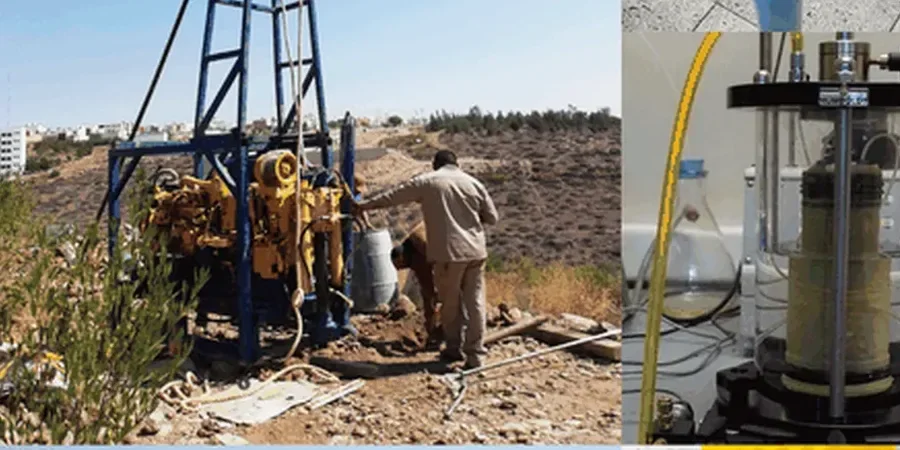
Service characteristics in Virginia Beach
Working video
Local geotechnical conditions in Virginia Beach
Virginia Beach has 35 miles of coastline and a network of tidal estuaries. Flood Zone AE covers large portions of the city, and post-Hurricane Matthew, the city updated its floodplain management rules. A soil mechanics study in Virginia Beach that ignores the saturation state of foundation soils is incomplete. Cyclic loading from storm surge and nor'easters can trigger excess pore pressure in fine sands, reducing bearing capacity temporarily. The 2011 Mineral earthquake, though centered in Louisa County, reminded local engineers that seismic demands per ASCE 7-22 are real even on the Coastal Plain. Site Class D or E soils amplify ground motion. If the report does not include liquefaction screening per Seed and Idriss methodology, the foundation design may be unconservative. The city's high water table also means buoyancy forces on underground structures must be calculated with the soil's actual permeability.
Our services
We provide two core service paths for soil mechanics investigations in Virginia Beach. Both are tailored to the site's specific geologic setting and the proposed construction type.
Full Geotechnical Laboratory Testing Suite
We run the full program: moisture content, Atterberg limits, grain size with hydrometer, UU and CD triaxial, direct shear, and one-dimensional consolidation. Each test follows the ASTM standard referenced in the project specifications. Results include interpreted strength parameters and compressibility curves ready for settlement analysis.
Foundation Engineering Analysis and Reporting
This is the deliverable that ties the lab data to the structural design. We calculate allowable bearing capacity using Vesic or Meyerhof methods, estimate total and differential settlement, and provide lateral earth pressure coefficients for retaining walls. The report includes a Site Class determination per ASCE 7 Chapter 20 and explicit recommendations for foundation type and depth.
Quick answers
How much does a soil mechanics study cost in Virginia Beach?
The cost for a soil mechanics study in Virginia Beach typically ranges from US$2,770 to US$4,480. The final figure depends on the number of borings, the depth of exploration, and the complexity of the lab testing program. A single-family home on a standard lot with two borings to 25 feet and basic index testing will be at the lower end. A commercial building requiring triaxial tests, consolidation tests, and deeper borings will be at the higher end.
How deep do the borings need to go for a Virginia Beach site?
Boring depth is determined by the structural loads and the site's stratigraphy. Per IBC Section 1803.5.5, borings must extend below all unsuitable material and penetrate competent bearing strata. For a typical two-story structure in Virginia Beach, we usually drill to 25 or 30 feet. For heavier structures or sites with deep soft clays, borings may extend to 50 feet or more. The depth must be sufficient to calculate settlement in the full stress bulb.
What is the difference between a soil mechanics study and a standard soil report?
A standard soil report often focuses on classification and basic bearing pressure. A soil mechanics study goes further. It quantifies the soil's engineering properties: shear strength, compressibility, and permeability. It provides the parameters needed for settlement calculations, slope stability analysis, and lateral earth pressure design. In Virginia Beach, where soft silts and high groundwater are common, a mechanics-level study gives the structural engineer the data to optimize the foundation rather than overdesign it.
How long does it take to get the final report?
Fieldwork and drilling are typically completed in one to two days. The laboratory testing program then runs for two to three weeks, depending on the number of consolidation and triaxial tests required. We can issue a preliminary verbal summary within five business days of completing the field work if the project schedule demands it. The final signed and sealed report follows once all lab data is reduced and the engineering analysis is complete.