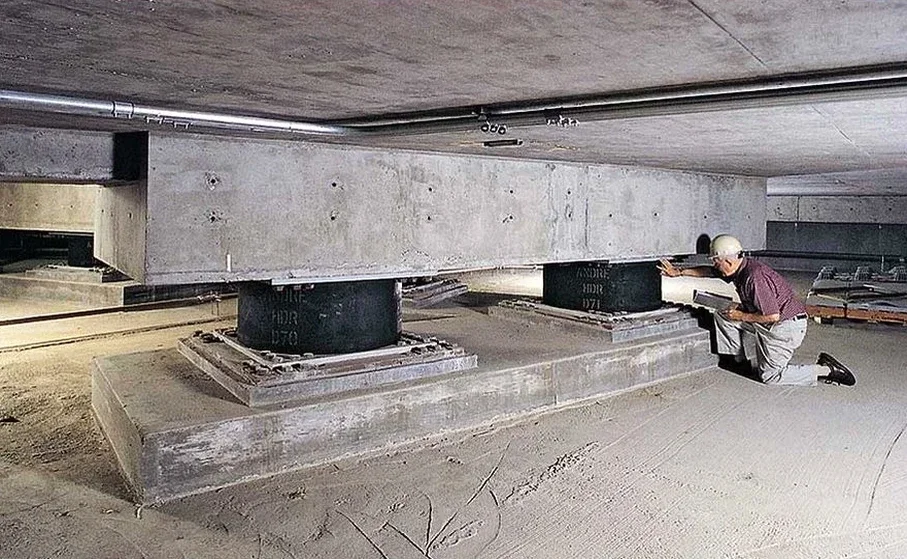
Virginia Beach sits at a curious convergence of environmental forces. The city’s Atlantic coastline exposes it to hurricane-driven storm surge and nor’easters, yet its subsurface geology also carries a measurable seismic hazard tied to the Central Virginia Seismic Zone. For structural engineers and developers working on critical facilities along the Lynnhaven River or near the oceanfront, designing for vertical and lateral loads alone is no longer sufficient. Base isolation seismic design introduces a mechanical decoupling layer between the superstructure and the foundation, absorbing energy that would otherwise transmit directly into the structural frame. When we pair this with subsurface data from seismic microzonation studies, we can fine-tune isolator properties to the specific soil profile, whether the site rests on loose Pleistocene sands or deeper Yorktown Formation sediments. Virginia Beach’s flat coastal plain topography masks the complexity beneath, and a generic isolation strategy without local geotechnical input often misses the mark.
A properly tuned base isolation system in Virginia Beach can reduce seismic force demands by up to 70 percent compared to a fixed-base design, but only when isolator properties match the actual subsurface profile rather than a generic site class.
Service characteristics in Virginia Beach
Local geotechnical conditions in Virginia Beach
ASCE 7-22 Chapter 17 and the IBC require a rigorous peer review and testing protocol for any base-isolated structure, and Virginia Beach jurisdictions enforce these provisions with particular attention to flood zone overlap. The greatest vulnerability we see in this market is the failure to coordinate the isolation plane’s elevation with FEMA flood maps; if the isolators sit below the Base Flood Elevation, the entire system becomes uninsurable and potentially noncompliant with local building ordinances. Another risk emerges from the assumption that flat coastal terrain implies uniform soil conditions. In reality, Virginia Beach contains buried paleochannels and compressible organic lenses that introduce differential settlement under the isolator pedestals, which can bind the moat wall clearances and compromise the isolation gap during a seismic event. The intersection of hurricane wind uplift, storm surge buoyancy, and seismic lateral displacement at the isolation interface demands a multi-hazard design philosophy that goes well beyond the standard isolated-building checklist.
Our services
Our base isolation design work in Virginia Beach spans new construction and seismic retrofit projects, always anchored in site-specific geotechnical data rather than generic assumptions. The following services represent the core of what we deliver to structural engineering firms and institutional clients along the Hampton Roads coastline.
Nonlinear Time-History Analysis for Isolated Structures
We develop full three-dimensional models incorporating isolator hysteresis, soil-structure interaction, and site-specific ground motion suites scaled to the Virginia Beach hazard deaggregation. Each model runs multiple ground motion pairs to capture directivity effects relevant to the Central Virginia Seismic Zone.
Isolator Specification and Peer Review Coordination
We prepare performance-based specifications for lead-rubber, high-damping rubber, and friction pendulum systems, then manage the independent peer review process required by ASCE 7 Chapter 17, coordinating with Virginia Beach building officials throughout the permit phase.
Geotechnical Site Characterization for Isolation Design
A base isolation design is only as reliable as the subsurface data behind it. We perform downhole shear wave velocity profiling, cyclic triaxial testing, and consolidation analysis to build the site response model that drives isolator displacement and period calculations.
Quick answers
What does a base isolation seismic design study cost for a Virginia Beach project?
For a typical mid-rise structure in Virginia Beach, the complete base isolation design package—including nonlinear time-history analysis, isolator specification, and peer review coordination—ranges from US$4,360 to US$8,450 depending on the structural complexity, number of ground motion pairs required, and whether a site-specific seismic hazard analysis is needed beyond the ASCE 7 mapped values.
How does Virginia Beach’s coastal soil profile affect base isolation performance?
The city’s subsurface commonly includes loose sands, soft organic silts, and high groundwater tables. Soft soil amplifies long-period motion, which can push an isolation system into resonance if the target period is not carefully tuned. We use downhole Vs30 measurements rather than default site class assumptions to set the isolation period and to estimate permanent displacement under the Maximum Considered Earthquake.
Is base isolation required by code for buildings in Virginia Beach?
Base isolation is not mandatory by the IBC for most occupancy categories, but for Risk Category IV structures—hospitals, emergency response facilities, designated shelters—the code permits and often encourages seismic isolation as an alternative to conventional force-based design. In Virginia Beach, where hurricane evacuation routes rely on functional critical infrastructure, isolation design is increasingly specified for public safety buildings to ensure post-event operability.