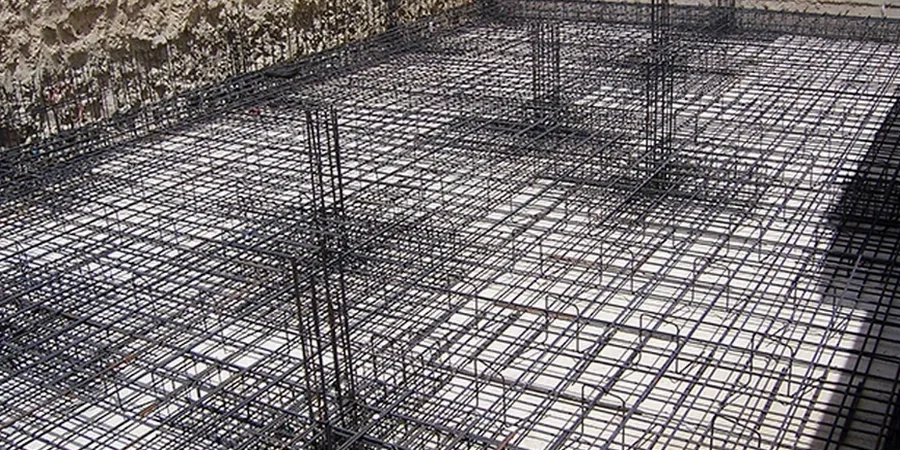
We recently wrapped up a design review for a mid-rise condominium project off Laskin Road where the geotech report showed six feet of loose silty sand over compressible organic clay, with groundwater at four feet. The structural engineer’s initial isolated footing layout would have required deep excavation well into the water table, leading to constant dewatering and differential settlement risks that were hard to control. The fix was switching to a raft/mat foundation design. By spreading the building load across the entire footprint, we reduced bearing pressure enough to float the structure on the upper sand layer without excavating into the problematic clay. That’s a scenario we see repeatedly along the Chesapeake Bay coastal plain, where soil stratigraphy changes abruptly across a single building lot. A well-calibrated raft/mat foundation design often becomes the most practical solution when the alternative involves costly deep foundations or extensive ground improvement.
On Virginia Beach coastal plain soils, a mat foundation often eliminates the need for deep piles by spreading loads across the most competent shallow stratum.
Service characteristics in Virginia Beach
Local geotechnical conditions in Virginia Beach
The difference in mat foundation performance between a site near the Oceanfront resort area and one further inland near the Great Dismal Swamp margin is night and day. At the Oceanfront, you’re often dealing with relatively clean medium-density sands deposited as ancient dune ridges—decent bearing, moderate settlement, and a water table that fluctuates with tide cycles. Move ten miles southwest toward the swamp transition zone, and the upper 20 feet can be nearly all compressible organic silt and peat, with SPT blow counts in the weight-of-hammer range. On those sites, even a thick raft/mat foundation design can experience long-term consolidation settlement exceeding tolerable limits if the organic layer isn’t bypassed or preloaded. We’ve seen projects where ignoring that transition between the sand ridges and the back-barrier marsh deposits led to angular distortion that cracked partition walls within two years. The IBC requires a geotechnical investigation that explicitly addresses differential settlement potential, and in this part of coastal Virginia, that means mapping the contact between the Tabb Formation sands and the underlying Yorktown clays with enough boreholes to catch lateral changes.
Our services
A reliable raft/mat foundation design in Virginia Beach starts with site-specific parameters that generic software defaults can’t provide. Our lab testing program feeds directly into the structural analysis model so the slab behaves as predicted.
Consolidation and Settlement Testing
One-dimensional consolidation tests on undisturbed samples from the compressible silts and clays beneath the mat footprint. We provide compression index, recompression ratio, and coefficient of consolidation to calibrate settlement-versus-time predictions.
Subgrade Reaction Modulus Evaluation
We derive the modulus of subgrade reaction from field plate load tests or correlations with SPT and CPT data, accounting for the influence zone depth of the mat. This value directly controls the bending moment and shear demand on the raft slab.
Soil-Structure Interaction Parameters
We compile a design report with allowable bearing pressure, expected total and differential settlement, spring constants for Winkler foundation modeling, and recommendations for underslab drainage where groundwater buoyancy is a concern.
Quick answers
When does a raft/mat foundation make more sense than isolated footings on a Virginia Beach site?
In our experience, the shift happens when the required footing size exceeds about half the building footprint area, or when differential settlement between adjacent footings is predicted to exceed half an inch. On the loose sands and soft silts common north of I-264, isolated footings often need to be so large they nearly touch, at which point a continuous mat is simpler to form and pour, and provides better resistance to water table uplift.
How much does a raft/mat foundation design investigation cost for a typical Virginia Beach project?
For a standard commercial or mid-rise residential project, the geotechnical investigation and lab testing package that feeds into a raft/mat foundation design typically runs between US$1,070 and US$4,470, depending on the number of borings, depth of exploration, and how many consolidation and strength tests are needed to characterize the compressible layers.
Do you need to account for hurricane storm surge buoyancy in the mat design?
Absolutely. Virginia Beach is in a FEMA coastal flood hazard zone for much of its developed area, and the IBC requires checking flotation and uplift during the design flood event. We calculate the submerged weight of the structure against the hydrostatic uplift pressure at the design flood elevation, and if the safety factor is below 1.2, we recommend increasing the mat thickness or adding tension piles to anchor the slab.
What lab tests are critical before finalizing a raft/mat foundation design here?
The non-negotiable tests are one-dimensional consolidation on the compressible strata (usually the Yorktown Formation silts), unconsolidated-undrained triaxial or unconfined compression on cohesive samples for undrained bearing capacity checks, and grain size analysis with Atterberg limits on all representative samples to confirm the USCS classification. If the water table is within the mat influence zone, we also run permeability tests to design any underslab drainage layer. More info.