Coastal Virginia Beach deals with a soil profile that surprises many builders: beneath the sandy surficial layer, pockets of highly plastic silts and clays from the Pleistocene-age Londonbridge Formation extend across the Lynnhaven River basin. These fine-grained deposits, often encountered at depths between 4 and 12 feet, can shrink and swell dramatically with seasonal moisture changes — a condition that directly impacts slab performance and pavement life. Our geotechnical laboratory runs routine Atterberg limits testing under ASTM D4318 to classify these materials per the Unified Soil Classification System, giving contractors the quantitative plasticity data needed before committing to a foundation type. When we pair these index results with grain-size distribution from the same Shelby tube sample, the engineering picture of the subgrade becomes unambiguous, allowing for confident decisions on undercut depth or chemical stabilization.
A four-point Atterberg determination on a Virginia Beach clay that plots above the A-line eliminates the guesswork from slab-on-grade design.
Service characteristics in Virginia Beach
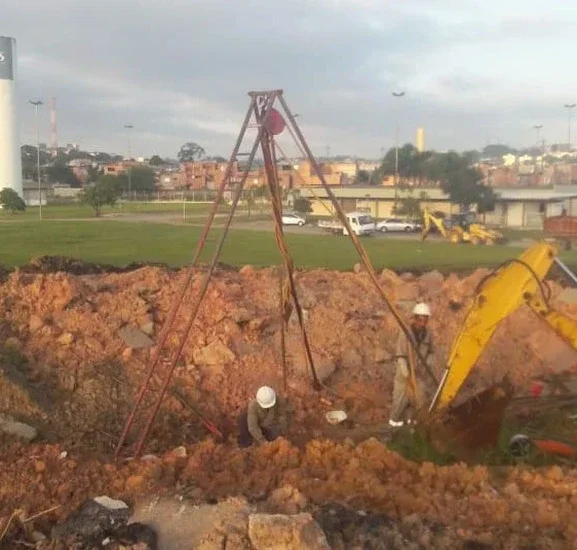
Local geotechnical conditions in Virginia Beach
Virginia Beach's post-war expansion pushed residential subdivisions into the low-lying marl and clay zones between the Lynnhaven and Rudee Inlet watersheds, areas where the natural soils can lose significant bearing capacity when the groundwater table — typically within 3 to 6 feet of the surface — rises after sustained rainfall events. A plasticity index that goes unreported before construction becomes a liability: we have seen slab distress in Kempsville neighborhoods where the original site investigation skipped Atterberg determinations on what visually appeared to be 'sandy silt' but tested as a CL with a PI of 22. The IBC mandates classification of all fine-grained foundation soils, and when the liquid limit exceeds 50 with a PI over 30, the soil enters the elastic silt or fat clay range where differential movement under lightly loaded footings becomes almost certain without mitigation. The cost of a few Atterberg tests is negligible compared to the expense of underpinning a settled structure five years after occupancy.
Our services
Our Virginia Beach soils laboratory provides Atterberg limits testing as part of a comprehensive fine-grained soil characterization package. The two service tiers below reflect the typical scope requested by local geotechnical and structural engineering firms.
Standard Atterberg Limits (LL, PL, PI)
Multi-point liquid limit using the Casagrande cup device and plastic limit by thread-rolling method on one disturbed sample. Includes USCS classification with plasticity chart plot and moisture content. Turnaround in 3–4 working days.
Full Soil Index Package
Atterberg limits plus hydrometer analysis, minus No. 200 wash, and specific gravity. Provides the complete particle-size distribution and plasticity data required for a defensible USCS dual-symbol classification and expansion potential assessment.
Quick answers
What is the standard cost range for Atterberg limits testing on a Virginia Beach clay sample?
For a single sample tested per ASTM D4318, the cost typically falls between US$70 and US$100. Volume pricing is available for projects requiring multiple samples from different boring depths.
How long does it take to receive the Atterberg limits report?
Standard turnaround is 3 to 4 working days from sample receipt. Expedited 24-hour processing can be arranged for active earthwork operations where the contractor needs immediate plasticity data to adjust moisture conditioning in the field.
Which Virginia Beach soils require Atterberg testing under the IBC?
Any fine-grained soil where more than 50% passes the No. 200 sieve must be classified by its Atterberg limits according to IBC 2021 Section 1803.5.3. This includes the silty clays encountered in the Western Branch and Creeds areas, where the plasticity index often exceeds 20 and governs foundation design assumptions.
Can you perform Atterberg limits on samples that contain organic material?
Yes, but the presence of organic matter — common in marsh-adjacent Virginia Beach soils near Owl Creek and Crystal Lake — will be noted on the report because it can artificially elevate the liquid limit. For organics exceeding 5% by mass, we recommend a loss-on-ignition complement to better characterize the material's behavior under load.
What sample quantity is needed for a complete Atterberg limits determination?
We require a minimum of 250 grams of material passing the No. 40 sieve, which typically translates to about 500 grams of bulk sample taken from a Shelby tube or split-spoon sampler. The sample must be sealed in a moisture-tight container immediately after extrusion to prevent drying before testing.