The most common mistake we see in Virginia Beach excavations is treating the water table as a secondary concern. The city sits on a coastal plain where the groundwater often sits just four to six feet below the surface, and a miscalculated anchor bond length in saturated sandy strata can lead to a slow, expensive wall deflection that no amount of post-tensioning will fix. Virginia Beach projects, from Lynnhaven inlet retaining structures to deep parking garages near the Oceanfront, demand a design that distinguishes clearly between active anchors, which are tensioned to control movement from the start, and passive anchors, which engage only as the soil mass begins to shift. We integrate this distinction into every calculation, drawing on local boring data and a working knowledge of the Pleistocene-age Norfolk Formation that underlies much of the city. For sites where the upper sands are particularly loose, we often specify a preliminary CPT test to map the stratigraphy continuously before determining the unbonded length of each tieback.
In coastal Virginia Beach, a well-designed active anchor transfers load beyond the failure wedge, but a poorly protected one becomes a corrosion cell in less than a decade.
Service characteristics in Virginia Beach
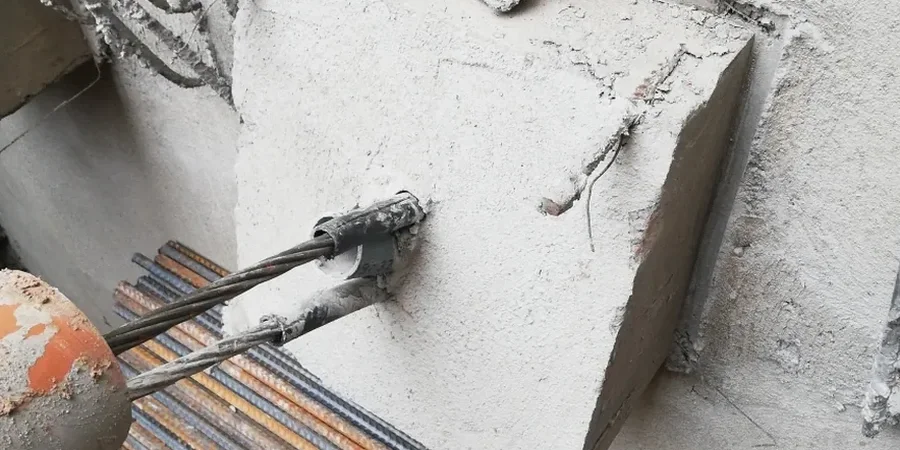
Local geotechnical conditions in Virginia Beach
Virginia Beach grew in a hurry after WWII, when farmland and tidal creeks were rapidly converted into subdivisions, and not every old creek bed shows up on a modern plat map. When you excavate near Thalia Creek or the old London Bridge corridor, you can hit buried organic silt lenses that have almost no shear strength, exactly where your passive anchor bond zone was supposed to engage. That kind of surprise turns a straightforward anchored wall into an emergency shoring situation. The IBC and ASCE 7 require a geotechnical investigation that identifies these soft zones, but the standard boring spacing sometimes misses them. We have learned to read the city's historic topographic maps and to correlate them with modern LiDAR data, looking for subtle depressions that hint at filled marshes. In those areas, we often extend the anchor bond length deeper into the competent Yorktown Formation or switch to a higher-density anchor layout. Ignoring these buried channels means the passive resistance you counted on simply does not exist, and the wall begins to rotate.
Our services
Our anchor design work in Virginia Beach is split into two distinct service categories, each tailored to the project's deformation tolerance and the site's subsurface profile.
Active Anchor Design and Testing
Full design of post-tensioned tieback systems including load determination, bond zone calculation, corrosion protection specification, and on-site performance testing according to PTI recommendations. Suited for Virginia Beach deep excavations where lateral movement must be minimized from the first day of cut.
Passive Anchor and Soil Nail Design
Design of grouted, untensioned anchors that engage through soil deformation, often used in slope stabilization along the intercoastal waterway or for temporary excavation support in the Sandbridge area. Includes pull-out capacity verification and global slope stability analysis with the anchor contribution modeled explicitly.
Quick answers
What is the typical cost range for an anchor design package in Virginia Beach?
For a standalone anchor design covering a single wall or slope, the fee generally ranges from US$920 to US$3,740, depending on the number of anchor rows, the complexity of the corrosion protection required, and the extent of field testing we need to run. A high groundwater site near Rudee Inlet that requires encapsulated anchors and multiple performance tests will fall on the upper end of that spectrum.
How do Virginia Beach's high groundwater levels affect anchor bond length?
High groundwater reduces the effective stress in the soil, which in turn lowers the unit bond resistance between the grout and the surrounding sand or clay. We compensate by extending the bond zone deeper into the competent stratum, often the Yorktown Formation, and by using a post-grouting technique that increases the radial stress around the fixed anchor length.
What is the difference between active and passive anchors in practical terms?
An active anchor is tensioned with a hydraulic jack immediately after installation, locking in a force that actively restrains the wall against lateral earth pressure. A passive anchor is installed without post-tensioning; it only develops resistance when the soil mass moves enough to stretch the tendon. Active anchors control deformation from the start and are preferred for sensitive adjacent structures.
Do you handle corrosion protection for anchors in brackish environments?
Yes. For any permanent anchor in Virginia Beach's brackish groundwater, we specify Class I corrosion protection per PTI DC35.1, which involves a corrugated HDPE duct filled with cement grout encapsulating the steel strand over the entire unbonded and bond length. We also specify epoxy-coated bearing plates and trumpet assemblies at the anchorage head.